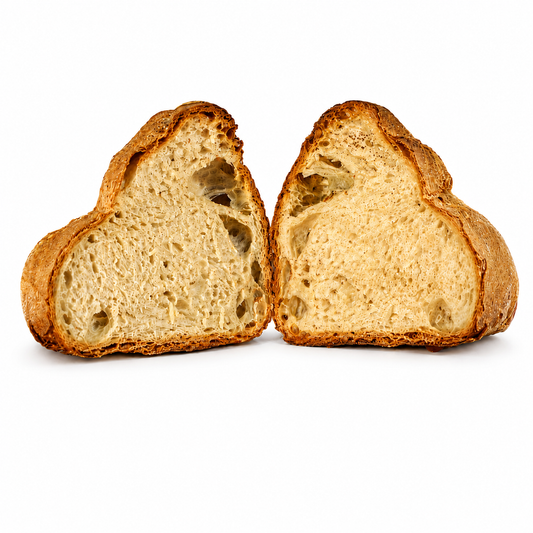
One of the most frequent questions when it comes to bread making is: how long should bread proof?
It's a simple question only in appearance, because the answer is never a precise number valid for all doughs. Those approaching the world of bread often look for a clear rule (an hour, two hours, overnight) but the reality is that proofing is not measured only in time, but in the transformation of the dough.
Understanding how long bread should proof means learning to observe, interpret, and recognize the signals that indicate when a dough is ready for the next stage. Time is only one element: what really matters is what happens inside the dough during fermentation.
What is proofing and what really happens in the dough
Proofing is the process by which yeasts convert sugars present in flour into gas, mainly carbon dioxide, and aromatic substances.
These gases, trapped in the gluten network developed during mixing, cause the dough to increase in volume and contribute to creating the bread's structure.
But proofing isn't just about growth. During this process, the following also occur:
- development of aromas
- transformation of sugars
- maturation of the dough
- improvement of internal structure
This is why well-managed proofing affects not only the appearance of the bread, but also its taste, digestibility, and preservation.
Why there isn't a single proofing time
Saying that bread should proof for "two hours" or "four hours" is not absolutely correct. Times can vary enormously because proofing depends on several factors that change from dough to dough.
Among the main factors are:
- type of yeast used
- amount of yeast
- type of flour
- hydration level
- ambient temperature
- duration and intensity of mixing
Even a minimal variation of these elements can significantly change the times.
For this reason, experienced bakers don't watch the clock, but observe the dough.
The main factors influencing proofing times
Temperature
It is one of the most decisive elements.
Dough left to proof in a warm environment will ferment much faster than one in a cold environment. Even a few degrees difference can radically change the times.
Higher temperatures accelerate the yeast's work, but can reduce the time for aroma development. Lower temperatures slow down the process, but allow for a more gradual and complete maturation.
Type of yeast
Brewer's yeast is faster and leads to shorter proofing times.
Sourdough works more slowly and requires longer times, but allows for more complex development.
Amount of yeast
Increasing the amount of yeast accelerates proofing, but it is not always the best choice. Proofing too quickly can compromise the aromatic development and structure of the bread.
Type of flour
Not all flours react in the same way. Stronger flours, with higher protein content, are able to sustain longer proofing. Weaker flours require shorter times.
Dough hydration
More hydrated doughs tend to develop differently and often require greater attention in managing times.
The stages of proofing: there isn't just one
When talking about proofing, it's important to know that there isn't just one stage.
Generally, the process is divided into two main moments:
First proofing, or bulk fermentation
This is the phase that occurs immediately after mixing the dough. In this phase, the dough rests and begins to develop structure and volume.
Second proofing, or final proof
This occurs after the bread is shaped. It serves to give the product its final shape and to prepare it for baking.
Both phases are fundamental and have different timings.
How long should bread proof in practice
Under standard conditions, dough with baker's yeast may require:
- 1 to 3 hours for the first proof
- 1 to 2 hours for the second
With sourdough, times can be significantly longer, even several hours or an entire night, depending on the process.
However, these numbers should always be considered indicative.
How to tell if the dough has proofed enough
More than time, it is important to recognize the signals from the dough.
A well-proofed dough generally exhibits:
- obvious increase in volume
- lighter structure
- slightly taut surface
- presence of small visible bubbles
A simple test involves gently pressing the dough with a finger. If the indentation slowly springs back without disappearing immediately, the dough is generally ready.
If it springs back too quickly, it still needs time.
If it doesn't spring back at all, it may have over-proofed.
Short vs. long proofing: what really changes
One of the most interesting aspects of bread making is the difference between short and long proofing.
Short proofing:
- is faster
- produces a more neutral bread
- is simpler to manage
Long proofing:
- develops more complex aromas
- improves the structure
- makes the dough more mature
- can improve digestibility
There isn't one absolutely correct choice, but those seeking quality and depth often prefer slower, more controlled processes.
The most common mistakes in managing proofing times
One of the most frequent mistakes is rigidly following a time without observing the dough. Each dough reacts differently, and ignoring this aspect can lead to inconsistent results.
Another mistake is rushing: shortening proofing times often leads to under-developed bread, with a compact structure and less flavor.
Similarly, letting it proof for too long can weaken the structure and make the dough difficult to handle.
Proofing is a matter of balance
Understanding how long bread should proof means finding a balance between time, temperature, ingredients, and observation.
There is no perfect formula, but there is a fundamental rule: learn to read the dough.
With experience, you learn to recognize when a dough is ready, regardless of the time elapsed. And it is precisely this ability that distinguishes a simple recipe execution from a true knowledge of bread making.
Our bread
-
Traditional Matera bread
Regular price From €13,99 EURRegular priceUnit price €7,00/kg -
Matera bread with cuts
Regular price From €13,99 EURRegular priceUnit price €7,00/kg -
Matera bread "croissant shaped"
Regular price From €13,99 EURRegular priceUnit price €7,00/kg -
Flat Matera bread
Regular price From €13,99 EURRegular priceUnit price €7,00/kg -
Grandpa Santino Bread
Regular price From €13,99 EURRegular priceUnit price €7,00/kg