

The Festa della Bruna is Matera's most important, deeply felt, and identity-defining celebration. It takes place every year on July 2nd and is dedicated to the Madonna della Bruna, the city's patron saint. For the people of Matera, it is not just the patronal feast of Matera, but an event that encompasses faith, memory, popular tradition, and a sense of belonging.
Every year the city transforms: the streets fill with people, the neighborhoods come alive, the historic center and the Sassi become the stage for a celebration that involves the entire community and attracts visitors, curious onlookers, and devotees from all over Basilicata and many other regions.
The origins of the festival date back to 1389, when Pope Urban VI officially established the celebration in honor of the Madonna della Bruna. Since then, July 2nd has become a symbolic date for Matera, eagerly anticipated and prepared with great participation. The strength of this festival lies precisely in its ability to unite diverse elements: religious devotion, collective ritual, the artisan tradition of papier-mâché, popular involvement, and that deep feeling that binds the people of Matera to their patron saint.
For those visiting Matera during this period, attending the Festa della Bruna means coming into contact with the city's most authentic soul. It is not just an event to see, but an experience to live firsthand, breathing in the intensity of a centuries-old tradition that still retains all its power today.
A celebration that accompanies Matera throughout the day
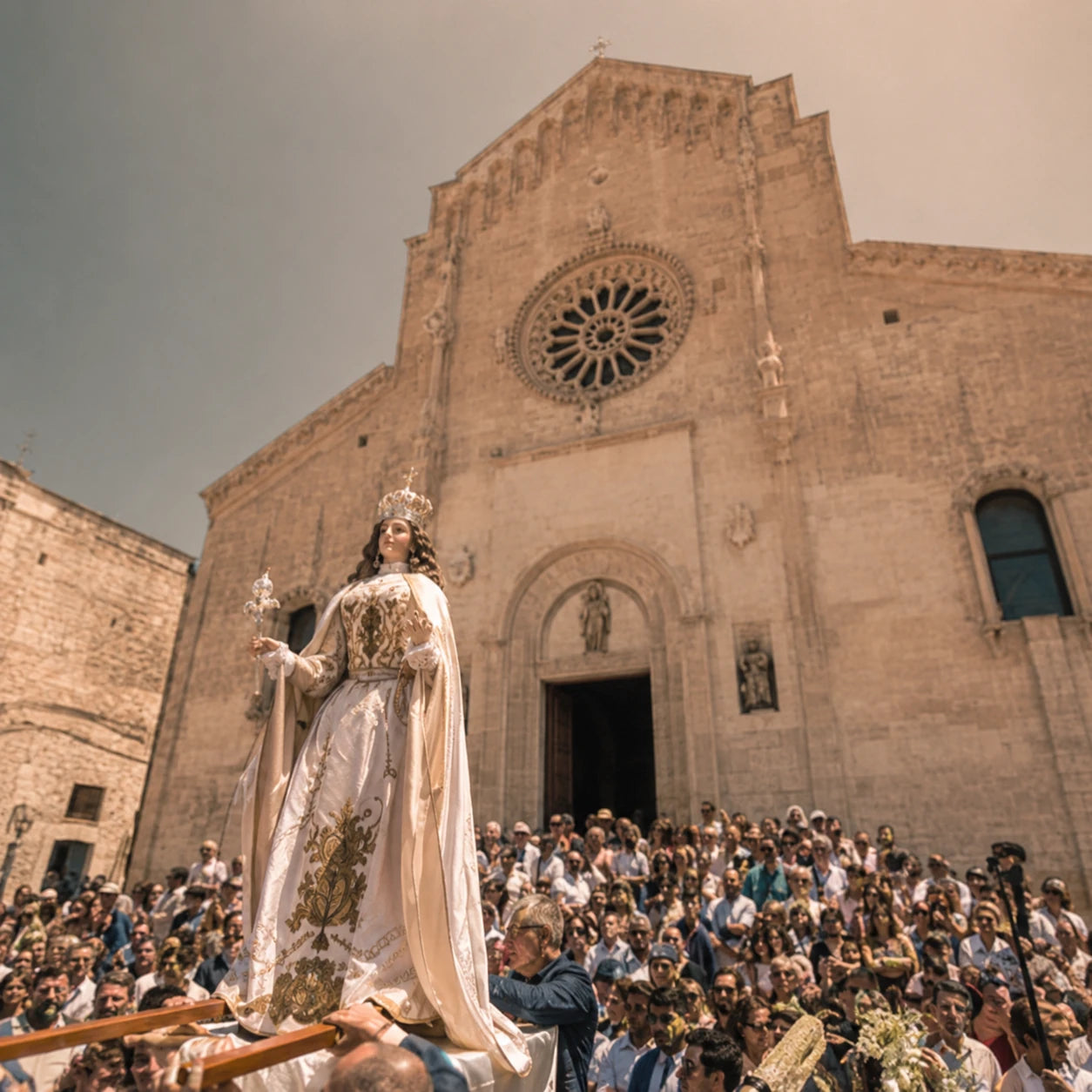
The Feast of the Bruna unfolds throughout the entire day of July 2nd with a program rich in religious moments, popular rites, processions, and symbolic events that follow one another from morning until late at night.
The day begins very early, at dawn, with the traditional shepherds' procession, one of the most evocative and deeply felt moments of the entire festival. The streets of Matera are traversed by groups of faithful accompanied by music, songs, and popular calls that evoke the ancient peasant roots of the celebration. It is a moment that preserves an intense and authentic atmosphere, capable of telling the deep connection between the city, faith, and the rural world that has shaped Matera's life for centuries.
During the morning, the religious celebrations dedicated to the Madonna della Bruna continue, along with solemn passages and moments of popular participation that enliven the city center. The city experiences a continuous crescendo: musical bands, knights, faithful, families, and visitors accompany the unfolding of the festival with a participation that involves all generations.
In the afternoon and late afternoon, attention increasingly focuses on the great historical parade and the passing of the triumphal float. It is here that the festival enters its most scenic and symbolic phase. Thousands of people pour into the streets to witness the passage of the float, accompanied by knights in costume, in a setting of anticipation and emotion that grows by the hour.
Finally, in the evening, we arrive at the most famous moment of the Feast of the Bruna: the traditional smashing of the float, followed by the grand fireworks display that illuminates the sky of Matera and symbolically concludes a day lived with absolute intensity. For the people of Matera, July 2nd is a date that is not observed as spectators: it is lived with the heart, with memory, and with a sense of participation that is renewed every year.
The Bruna's Cart: the most spectacular symbol of the festival


The absolute star of the Festa della Bruna is the triumphal float of the Madonna della Bruna, an extraordinary papier-mâché artwork created by Matera's artisans. It is one of the most recognizable elements of the festival and, for many, also the most powerful symbol of popular devotion to the city's patron saint.
Every year, the float is designed and built by a local artist who works for months on its creation. Nothing is left to chance: the design changes with each edition and is inspired by religious themes, Marian symbols, references to Christian spirituality, and allusions to the history of Matera. This is precisely why each float is unique and unrepeatable, destined to live for only one day and then remain in the memory of those who participated in the festival. From an artistic point of view, the float represents one of the highest expressions of Matera's papier-mâché tradition. The decorations, statues, ornamental elements, and sacred figures are hand-made with great care, transforming the float into a true mobile set with an extraordinary visual impact. Its grandeur strikes anyone who sees it live: it is a monumental structure, rich in details, capable of attracting attention and evoking wonder.
Yet, its value does not lie in its material durability. On the contrary, the deepest meaning of the Bruna float lies precisely in its ephemeral nature. It is built to be admired, carried in procession, and finally destroyed. In this aspect lies one of the strongest and most original meanings of the entire festival.
The Historical Parade and the Knights' Procession
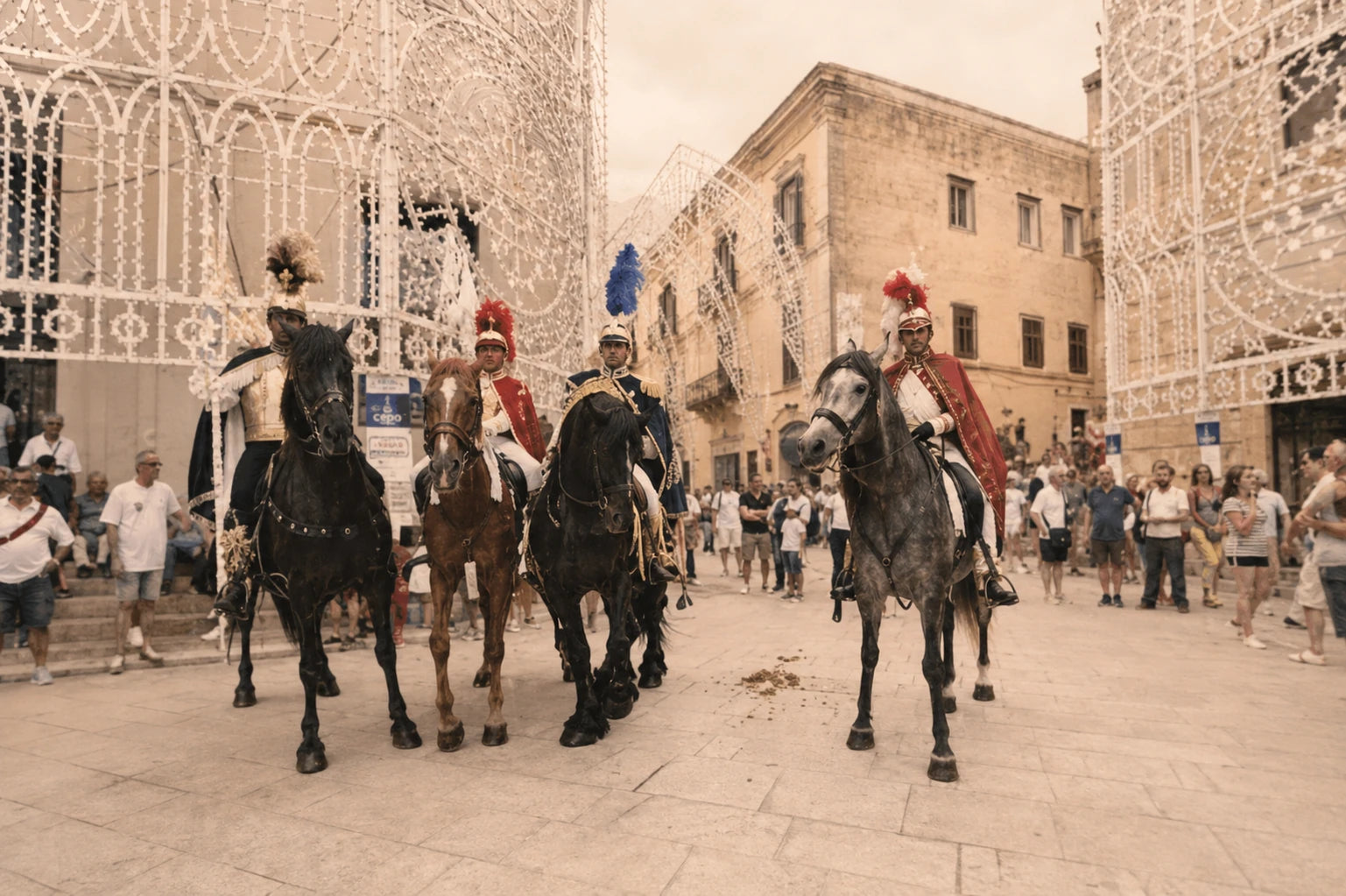
Among the most anticipated moments of the Festa della Bruna is the historical parade, which accompanies the procession of the float and enriches the celebration with a strong scenic and symbolic component. The knights of the Bruna, in traditional attire, pass through the city streets participating in one of the most solemn and admired moments of the entire day.
The presence of the knights helps to give the festival a strong sense of identity. It is not just a parade, but an integral part of a tradition that Matera has preserved for centuries and which still today moves residents and visitors alike. The passage of the parade through the streets of the historic center, amidst crowds, music, and anticipation, further intensifies the perception of witnessing an event deeply rooted in the city's history.
The ripping of the cart: the most famous ritual of the Festa della Bruna
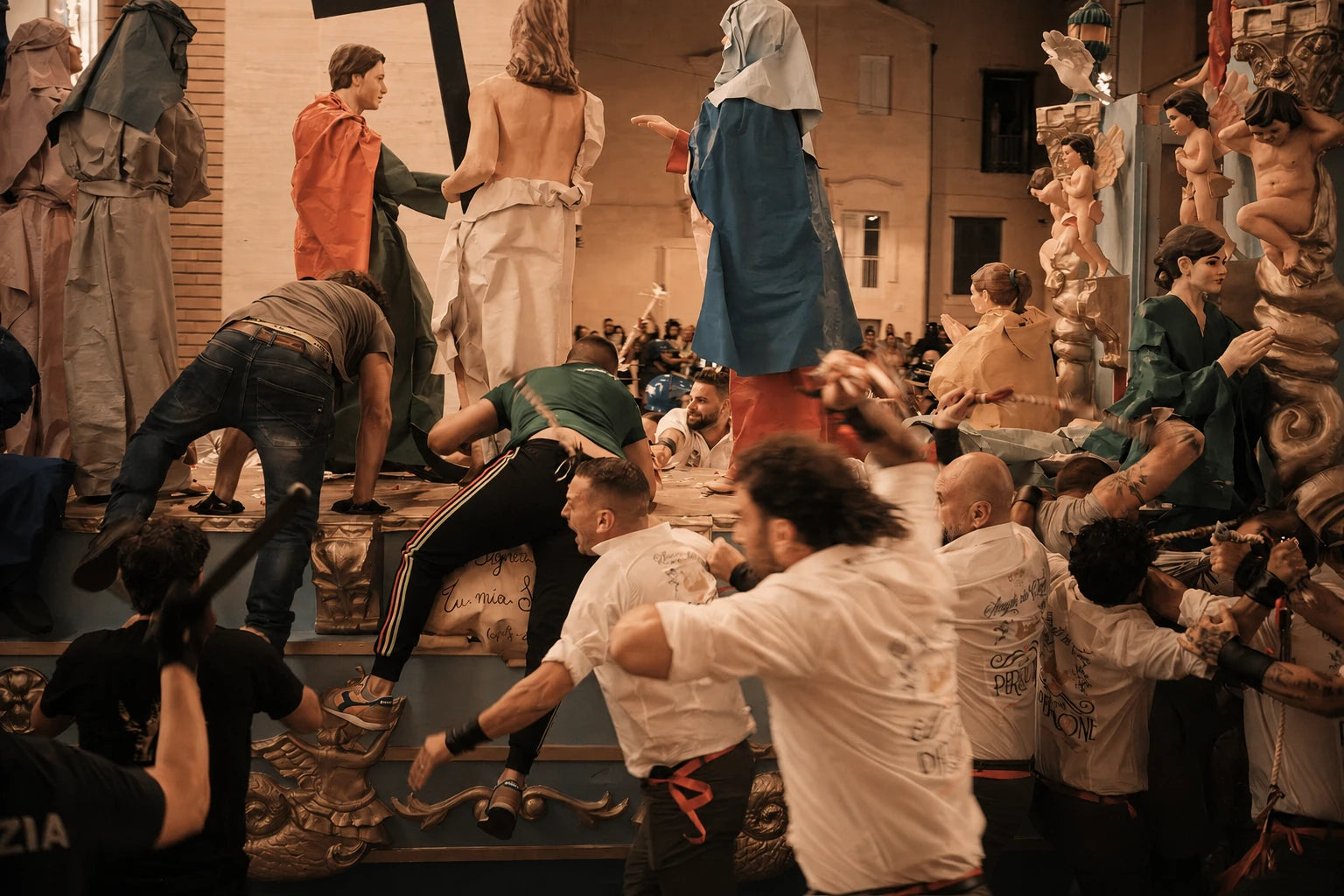
The most famous, intense, and spectacular moment of the Festa della Bruna is undoubtedly the shredding of the cart (strazzo del carro). It is the ritual that, more than any other, intrigues those who hear about the festival for the first time, and it attracts thousands of people to the heart of Matera every year.
After traversing the city during the evening procession, the triumphal cart is led to Piazza Vittorio Veneto, where the crowd gathers, awaiting the final moment. The atmosphere is electric, charged with tension and participation. Everyone knows that the most symbolic act of the festival is about to take place.
At a precise signal, the crowd surges towards the cart and assails it, destroying it and tearing off pieces of papier-mâché. Participants try to take away a fragment of the cart as a souvenir and a sign of good luck for the following year. It is an act that might seem surprising to an outside observer, but in Matera, it holds profound meaning, passed down through time and experienced with immense intensity.
The shredding is not just the physical destruction of the cart: it is a collective ritual that merges historical memory, popular energy, tradition, and the desire for direct participation. For this very reason, it is one of the most emblematic moments of the Festa della Bruna and one of the most unique events to see in Matera.
The Historical Significance of the "Strazzo"
Over time, various interpretations have been proposed regarding the meaning of the cart's "strazzo" (tearing apart). One of the most widespread connects this symbolic gesture to the rebellion of the people of Matera against Count Giovan Carlo Tramontano, lord of Matera in the 16th century, a figure historically linked to a difficult period in the city's life.
According to this interpretation, the assault on the cart represents the strength of the people and liberation from a power perceived as oppressive. Beyond historical interpretations, what truly matters is that even today, the "strazzo" remains one of the city's strongest and most recognizable collective rituals.
It is precisely at this moment that the Festa della Bruna shows all its uniqueness: a celebration where religious devotion coexists with the most intense popular participation, creating an event that is unparalleled among Italian patron saint festivals.
The Legend of the Madonna della Bruna
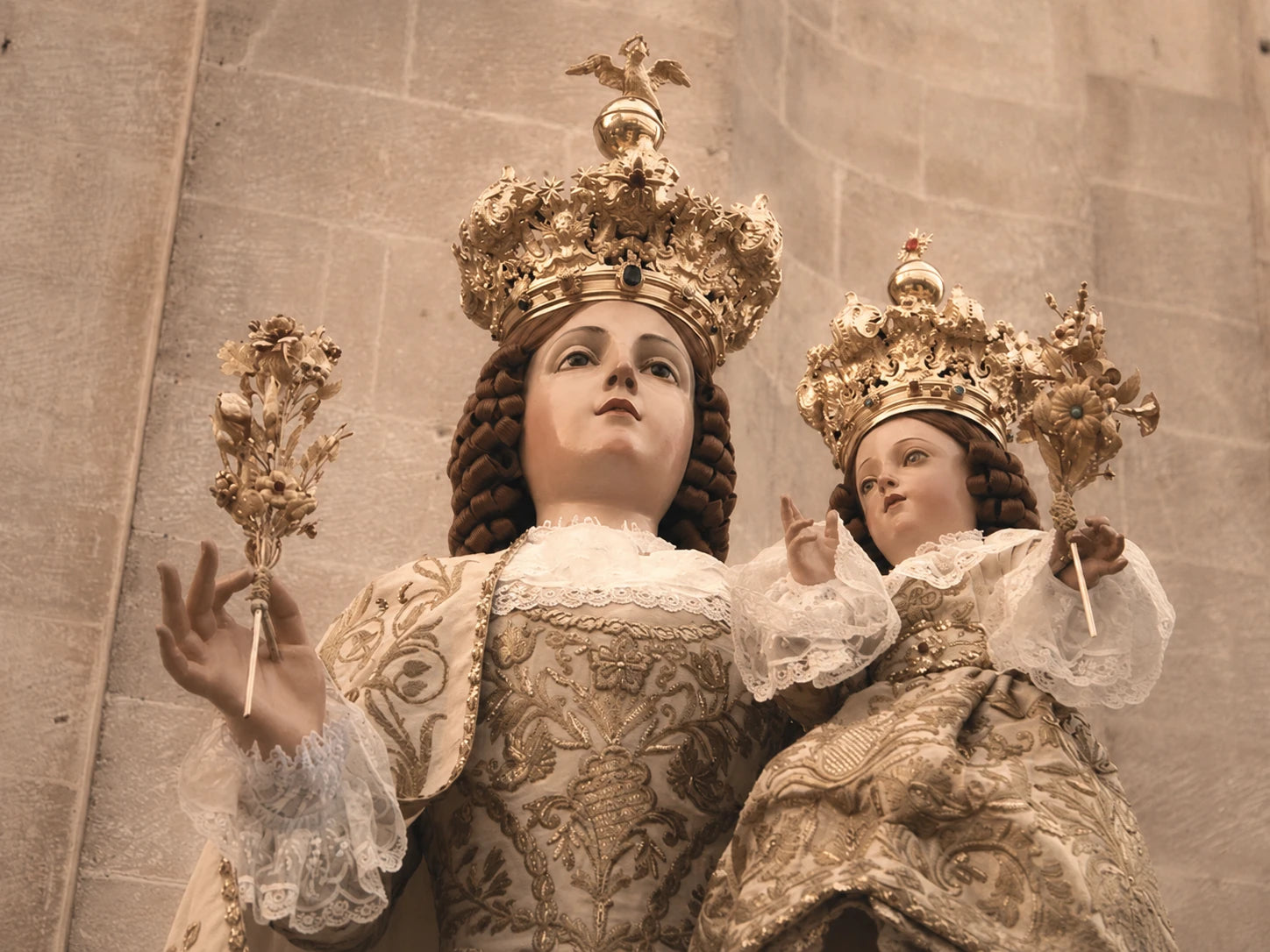
Alongside the official history of the festival, there is also a very popular folk legend, which symbolically narrates the origin of the devotion to the Madonna della Bruna.
It is said that one day a farmer was returning to Matera with his cart when he met a young woman dressed in dark clothes, carrying a child in her arms. The woman asked him for a ride into the city. The farmer agreed and took her to the gates of Matera. When they reached a church, the woman got off the cart and asked him not to tell anyone who had accompanied her. Shortly after, however, she mysteriously disappeared. The farmer then understood that the woman was the Madonna, who had chosen Matera as her city. This legend, passed down orally for generations, still forms part of the collective imagination associated with the Festa della Bruna today. It is one of the stories that best expresses the deep, affectionate, and spiritual relationship between the Madonna della Bruna and the people of Matera.
Why the Feast of the Bruna is so important for the people of Matera
To truly understand the Festa della Bruna, one must comprehend that for the people of Matera, it is not merely a religious celebration or a tourist event. July 2nd is a date that speaks of belonging, family memory, shared emotion, and civic identity.
Every Materan family holds a memory connected to the festival: an anticipation experienced as a child, a fragment of the float carefully preserved, a procession followed with relatives, a story handed down by grandparents. The Festa della Bruna is also this: a collective memory that is renewed and transmitted every year.
It is for this reason that visitors to Matera during the festival immediately perceive an atmosphere different from that of a simple public event. Here, participation is never detached. Everything speaks of authentic involvement, civic pride, and a deep connection to tradition.
Experiencing the festival through the eyes of a Matera native


For those visiting Matera, the Festa della Bruna is a unique experience that allows you to truly enter into the spirit of the city.
Francesco Perrone, owner of Panificio Perrone since 1890, experiences this day in a very special way. Every year he participates in the festival both as a knight and as an "assaltatore" (attacker) of the cart, taking direct part in the most intense moments of the celebration.
In the video at the bottom of the page⭣ he recounts firsthand what it means to experience July 2nd in Matera, sharing emotions, memories, and traditions that are part of the lives of the people of Matera.
Inside Panificio Perrone, moreover, some original statues from the Bruna cart are displayed, recovered by Francesco himself during the cart's destruction. Visiting the bakery therefore not only allows you to taste typical products of Matera's tradition, but also to see up close some authentic fragments of this extraordinary festival.
A festival to see at least once in Matera
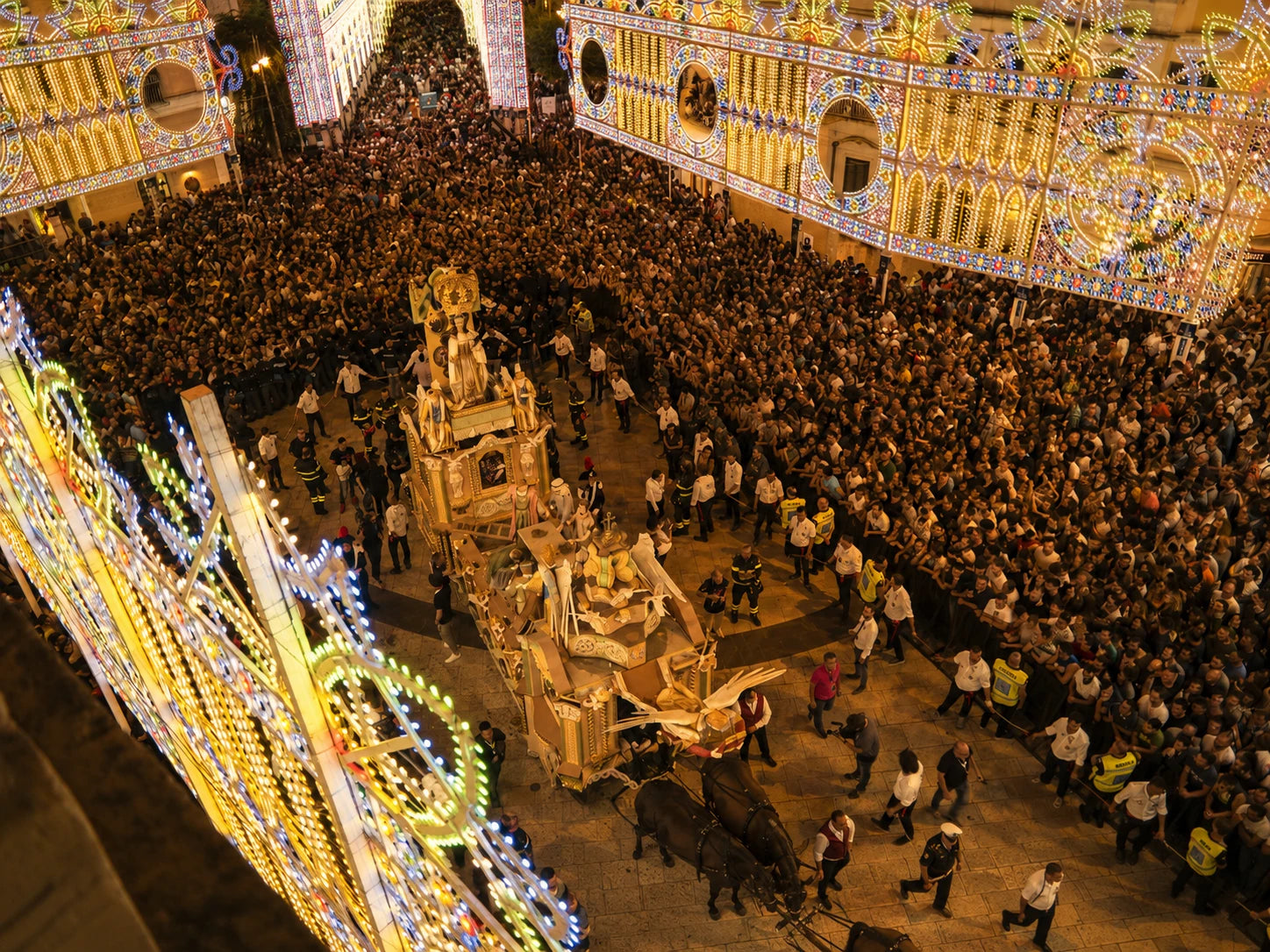
Those who have the opportunity to be in the city on July 2nd experience one of the most intense and memorable days of the entire Lucanian calendar. The Feast of the Bruna is, in fact, much more than a local event: it is one of the most famous popular celebrations in Basilicata and one of the most unique patron saint festivals in Italy.
Amidst processions, knights, historical parades, the triumphal float, the "strazzo" (destruction), and fireworks, the entire city transforms into a large open-air theatre. But its true strength lies not just in the spectacle. It lies above all in the collective participation, the continuity of tradition, and the ability to tell the deepest soul of Matera.
The torment in first person
Frequently Asked Questions
When is the Feast of the Bruna celebrated?
The Festa della Bruna is celebrated every year on July 2nd in Matera and is dedicated to the Madonna della Bruna, the patron saint of the city. It is the most important religious and popular event in the Matera calendar.
What is the tearing of the Bruna's chariot?
The "strazzo del carro" (tearing of the cart) is the final and most celebrated moment of the Festa della Bruna. After the evening procession, the triumphant papier-mâché float is stormed by the crowd and destroyed in Piazza Vittorio Veneto. Participants take pieces of the float as a souvenir and a symbol of good luck.
Why is the cart of the Bruna destroyed?
The destruction of the Bruna's cart is an ancient symbolic ritual that represents popular participation in the festival and, according to one of the most widespread historical interpretations, recalls the rebellion of the people of Matera against feudal power. Today it is one of the most anticipated and spectacular moments of the celebration.
Who builds the Bruna float?
Every year, the Bruna float is designed and built by a local artisan specializing in papier-mâché. The float is constructed in the months leading up to the festival and features a completely new design each year.
How long does the Feast of the Bruna last?
The Feast of the Bruna lasts for the entire day of July 2nd, starting at dawn with the procession of shepherds and concluding late in the evening after the dismantling of the float and the final fireworks.
Is it worth visiting Matera during the Feast of the Bruna?
Absolutely. Visiting Matera during the Festa della Bruna means experiencing one of the most authentic and spectacular folk traditions of Southern Italy. It's a unique opportunity to discover the city at its peak of emotional and identitary involvement.
