

Origins, millennial history, and rebirth of the city symbol of Basilicata
Located in the heart of Basilicata, on the southern side of the Murgia plateau, Matera is considered one of the oldest continually inhabited cities in the world. Its uniqueness lies not only in its millennial age but also in how humans have managed to inhabit a challenging landscape, slowly transforming it into a unique city.
The Sassi of Matera, now known worldwide, are the result of a long and profound relationship between nature and daily life. The caves, courtyards, cisterns, rock-hewn churches, and homes carved into the calcarenite show how the city grew by adapting to the territory, without erasing it.
In 1993, the Sassi of Matera were recognized as a World Heritage Site by UNESCO, becoming the first site in southern Italy to receive this prestigious recognition. In 2019, Matera was the European Capital of Culture, a step that definitively established the city as one of Europe's most fascinating cultural destinations.
But Matera's history is not just about accolades. It is a story of hardship, abandonment, redemption, and rebirth. A story that begins in prehistory and extends to the contemporary city, passing through centuries of rupestrian life, dominations, poverty, popular traditions, and cultural recovery.

The Sassi of Matera: a city built into the rock
The Sassi of Matera are the oldest and most recognizable heart of the city. They are divided into two main districts, the Sasso Caveoso and the Sasso Barisano, ideally separated by the Civita, the highest and oldest nucleus on which the Cathedral also stands.
The Sasso Caveoso retains a more rocky and scenic appearance, with houses that seem to cling to the rock and overlook the Gravina gorge. The Sasso Barisano, on the other hand, shows a greater presence of masonry constructions, facades and superimposed environments, while maintaining the same deep relationship with stone.
What is striking about the Sassi is their structure. Matera is not a city built according to a regular plan, but an urban organism that grew following the shape of the land. The houses are arranged on different levels, the streets go up and down, roofs become passages, courtyards become shared spaces, private and public spaces constantly intertwine.
This architecture does not originate from an abstract project, but from centuries of adaptation. Each family, each generation, each community has added, excavated, modified and recovered spaces according to the needs of the moment. This is why the Sassi are so fascinating: they do not seem built once and for all, but have grown slowly as part of the landscape.
Today, walking through the Sassi means traversing a vertical city, made of stairs, arches, terraces, caves and sudden panoramic views. It is an experience difficult to compare to other Italian historical centers, because Matera does not only offer monuments to visit: it offers a completely different way of understanding urban space.
The water collection system: the ingenuity hidden beneath the city
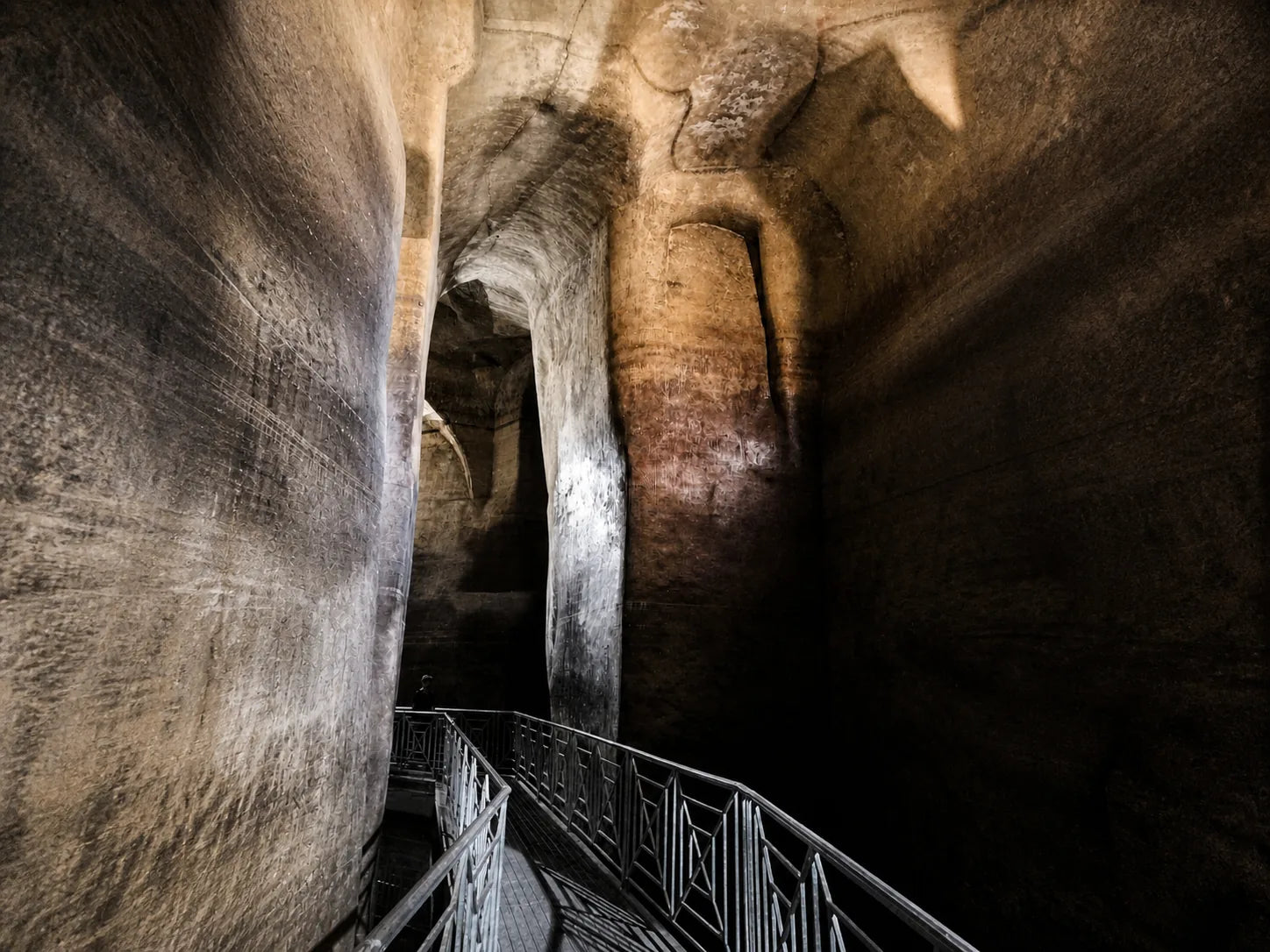
One of the most surprising aspects of Matera's history is its relationship with water. At first glance, the territory appears arid, marked by rock and the Gravina canyon. Yet, precisely in such a challenging environment, the inhabitants developed an ingenious system over centuries to collect, conserve, and utilize rainwater.
The dwellings in the Sassi were often connected to cisterns carved into the rock. Water was channelled through canals, natural slopes, and collection systems that allowed every available drop to be used. Nothing was left to chance: the very structure of the city contributed to water resource management.
This system was not only practical but essential for survival. In a city where water was not abundant, conserving it meant being able to live, cultivate, raise animals, and maintain a stable community.
The large cistern of the Palombaro Lungo, located beneath Piazza Vittorio Veneto, is one of the most well-known examples of this hydraulic expertise. But the true value of the Matera system lies in its widespread diffusion: not a single monumental work, but a network of daily solutions integrated into the very form of the settlement.
It is also for this reason that Matera is often cited as an ancient example of sustainability. Long before this word became common, the city had already learned to coexist with its environment, exploiting its resources without separating from it.
Matera in the Middle Ages: Encounters, Dominations and Religious Life
After the Roman era and with the progressive transformation of Southern Italy, Matera went through complex centuries, marked by the passage of different peoples, powers, and cultures. Lombards, Byzantines, Normans, Swabians, Angevins, and Aragonese all contributed, at different times, to shaping the city's identity.
The Middle Ages were a decisive period for Matera. The Sassi consolidated their residential structure, and the city assumed an increasingly recognizable role in the surrounding territory. Its position, overlooking the Gravina and connected to the internal routes of Basilicata and Puglia, made it an important center from a strategic, agricultural, and religious point of view.
During these centuries, the city's spiritual dimension also developed strongly. Monks, religious communities, and local populations created a heritage of rock churches that still represents one of the most precious testimonies of medieval Matera.
Matera's history cannot be read as a sequence of external dominations. Each transition left something behind, but the city always re-elaborated these influences in its own way, maintaining an identity deeply connected to the rock, work, and community.
Rock churches: faith, art and silence in stone
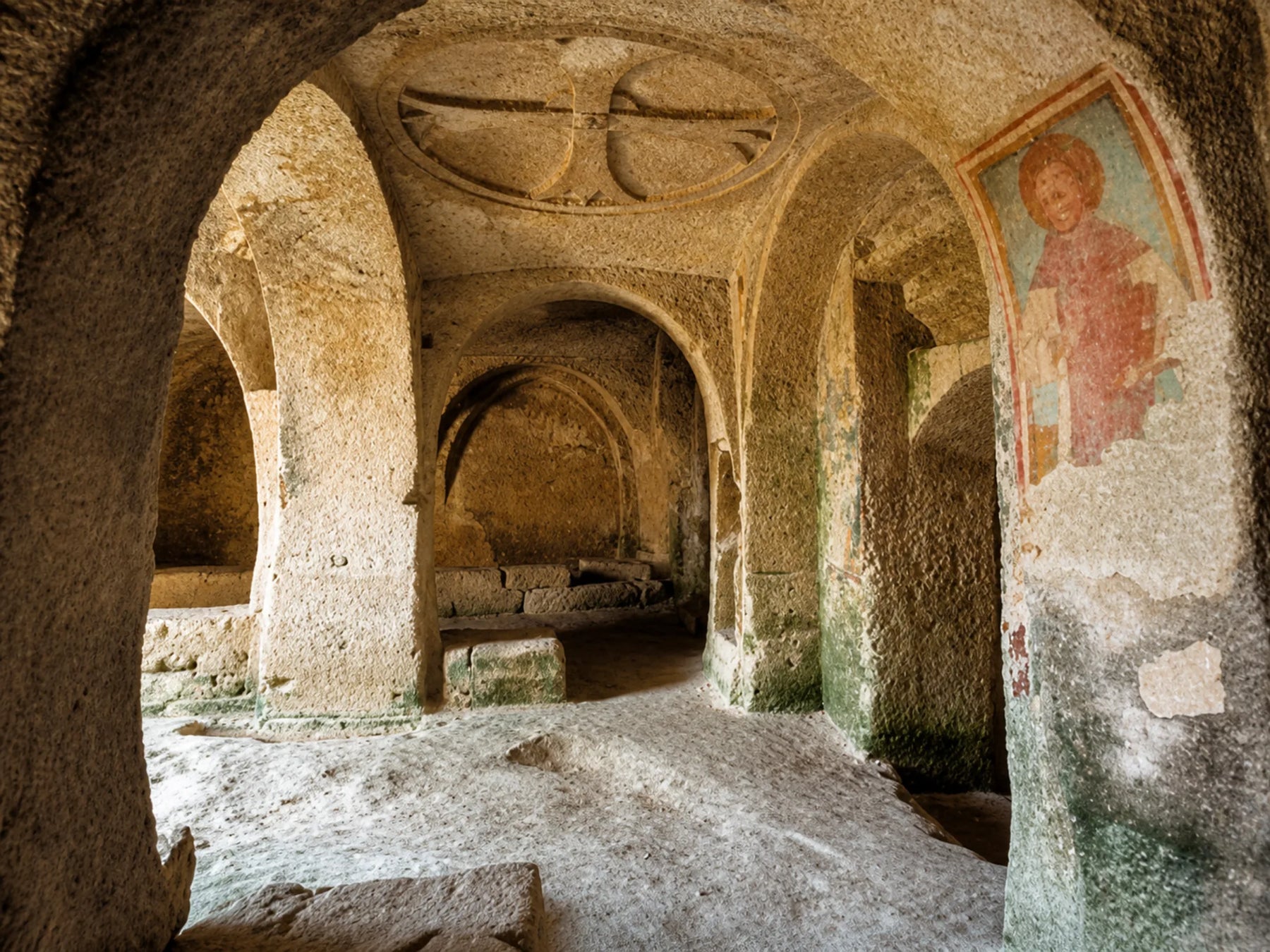
The rock churches are among Matera's most fascinating places. Carved into the rock, often hidden among caves, paths, and the walls of the Gravina, they tell a story of ancient spirituality deeply connected to the landscape.
Many of these churches preserve valuable frescoes, often influenced by Byzantine culture. The sacred images, colors, figures of saints, and religious scenes show how Matera was a meeting point for diverse spiritual traditions, particularly between the Latin and Eastern worlds.
Visiting a rock church means entering an intimate, secluded space, far from the monumentality of grand cathedrals. Here, faith was expressed in the simplicity of the rock, in the light entering through small openings, and in the silence of the carved environments.
These places were not merely spaces for prayer. They were also concrete signs of the presence of religious communities, monastic life, and the deep relationship between inhabitants and the territory. Today, they represent one of the city's most important artistic heritages and contribute to making Matera a unique destination for those who love history, art, and spirituality.
Life in the Sassi between the 19th and 20th Centuries
For many centuries, the Sassi were the center of daily life in Matera. Large families lived here, often in homes consisting of just a few rooms, sharing spaces with pets and tools. Life was hard, dictated by the rhythms of agriculture, animal husbandry, and daily necessities.
However, one should not imagine the Sassi solely as a place of destitution. They were also a world rich in relationships, customs, and solidarity. The vicinati, small common spaces overlooked by multiple dwellings, were the heart of social life. Here people talked, worked, shared news, helped neighbors, and passed down traditions.
The family played a central role, but life was never entirely private. Many activities took place outdoors or in shared spaces. The oven, the cistern, the courtyard, the street, and the vicinato were places of encounter and collaboration.
Bread, in this context, held immense value. Each family prepared their own dough and took it to be baked in communal or neighborhood ovens. It was not just a food, but a symbol of work, survival, and family continuity.
The Evacuation of the Sassi and the Difficult Post-War Period
After the Second World War, the situation of the Sassi became a national issue. The hygienic-sanitary conditions were serious: many families lived in overcrowded environments, with poor ventilation and insufficient services. The contrast between the extraordinary antiquity of the places and the harshness of daily life attracted the attention of intellectuals, journalists, and politicians.
Carlo Levi's book Christ Stopped at Eboli played a decisive role in making the reality of inland Basilicata and the conditions in Matera known to the rest of Italy. Matera was defined, with an expression that became famous, as a "national disgrace." A harsh definition that weighed on the city's image for many years but also helped initiate change.
In 1952, the Italian State approved a special law for the rehabilitation of the Sassi. Thousands of inhabitants were transferred to new neighborhoods built in the modern part of the city. It was a painful and complex transition: on the one hand, it improved the living conditions of many people; on the other hand, it suddenly emptied a world made of relationships, habits, and memory.
For decades, the Sassi remained largely abandoned. The cave-houses, once full of life, became silent places. Matera entered a difficult phase, suspended between the weight of the past and the search for a new identity.

Matera European Capital of Culture 2019
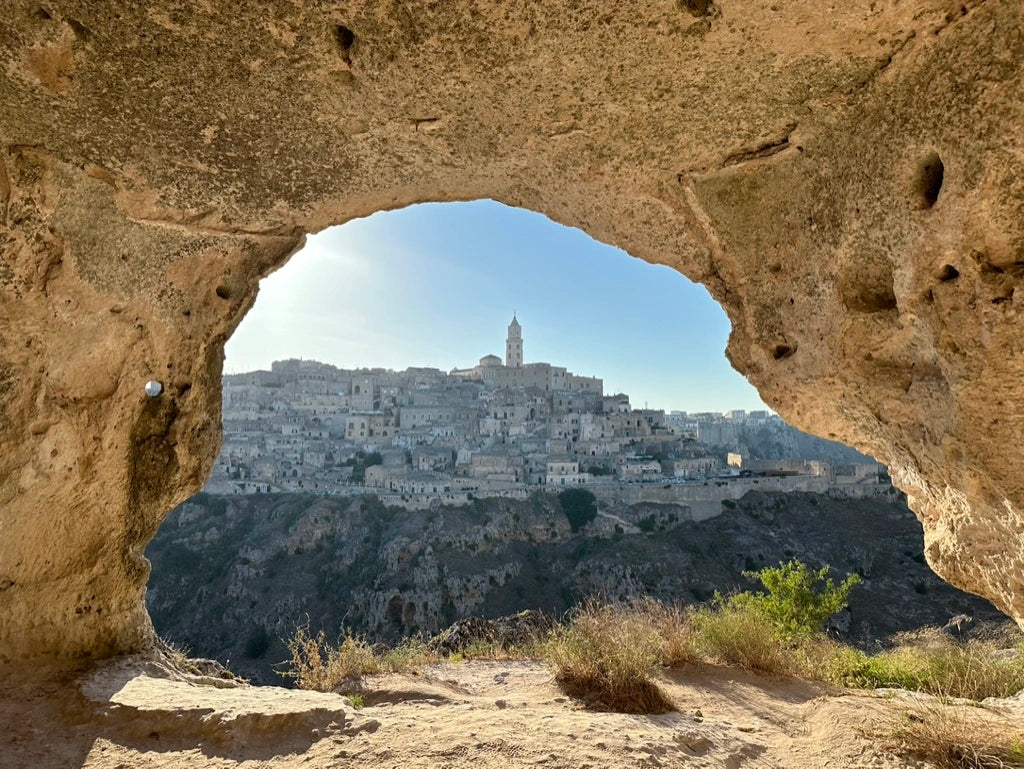
Matera's journey of rebirth reached a new turning point in 2019, when it became the European Capital of Culture. It was a moment of great international visibility, but also the result of a long path built on recovery, participation, and the enhancement of its heritage.
The year as European Capital of Culture brought events, projects, exhibitions, meetings, and new energy to the city. Matera presented itself to the world not as a museum-city, stuck in its past, but as a vibrant place capable of transforming its history into a resource for the future.
Since then, tourism has grown significantly, and Matera has steadily become one of Southern Italy's most desired destinations. However, the city's value lies not only in its scenic beauty but in its ability to tell a profound human story: that of a community that has navigated abandonment, redemption, and international recognition.
Contemporary Matera: from the Sassi to international cinema
Today Matera is a city known throughout the world, but it still retains a deeply authentic soul. The Sassi have come back to life and are home to residences, artisan workshops, museums, scattered hotels, restaurants, shops, and cultural spaces. The stone that for centuries preserved the daily life of its population today continues to tell the city's story, but with a new language, one of hospitality, culture, and creativity.
In recent years, Matera has also become a film set of great international appeal. Among the most famous productions filmed in the city is No Time to Die, a James Bond saga film released in 2021, in which some scenes are set among the Sassi, the Civita, and the city's monumental views. The presence of 007 further strengthened Matera's image as a scenic, recognizable place capable of speaking to a global audience.
Visiting Matera today therefore means passing through a city where past and present coexist in a surprising way: on the one hand, the millennial history of the caves, rock churches, and neighborhoods; on the other, a vibrant, international city that is increasingly central to the cultural routes of Southern Italy. To discover the most beautiful places, panoramic views, and unmissable stops, you can also read our guide on what to see in Matera.
Matera is not just a city to observe: it is a place to experience slowly, entering its alleys, listening to stories, tasting local flavors, and letting yourself be guided by the millennial history that characterizes this place.
Frequently Asked Questions
Why is Matera famous worldwide?
Matera is famous worldwide for its renowned Sassi, ancient districts carved into the rock that represent one of the most extraordinary examples of rupestrian architecture in existence. The city is also known for its millennial history, for the UNESCO recognition it received in 1993, and for having been the European Capital of Culture in 2019.
Why are the Sassi di Matera a UNESCO World Heritage site?
The Sassi di Matera were declared a UNESCO World Heritage site because they represent a unique example of human settlement capable of perfectly adapting to the natural environment over millennia. Their historical, urban, and cultural value is considered exceptional worldwide.
How old is the city of Matera?
The first traces of human presence in the territory of Matera date back to the Paleolithic era. Stable settlements developed as early as around 7000 BC, making Matera one of the oldest continuously inhabited cities in the world.
What does the name "Sassi di Matera" mean?
The term "Sassi" refers to the ancient historic districts of Matera, carved into the calcarenite rock of the Gravina. The two main districts that make up the Sassi are Sasso Caveoso and Sasso Barisano.
When to visit Matera?
Matera can be visited all year round, but the best times are spring and autumn, when the weather is mild and ideal for walking through the Sassi and visiting the historic center. Summer also offers a charming atmosphere, especially in the evening.
How much time do you need to visit Matera?
To visit Matera properly, it is advisable to dedicate at least one or two days. One day allows you to see the main points of interest, while with two days you can experience the city more calmly and explore the less touristy areas.
